5 Reasons Why Customer Learning Belongs in Your Builder Tooling Budget
Customer learning is easier to fund as builder tooling. 5 reasons product leaders should move it out of the research budget, and how to start.
For product leaders planning how their org learns from customers in 2027.
Customer learning is much easier to fund when you plan it as a tool for everyone who builds. Most product orgs still file it under the research team's budget.
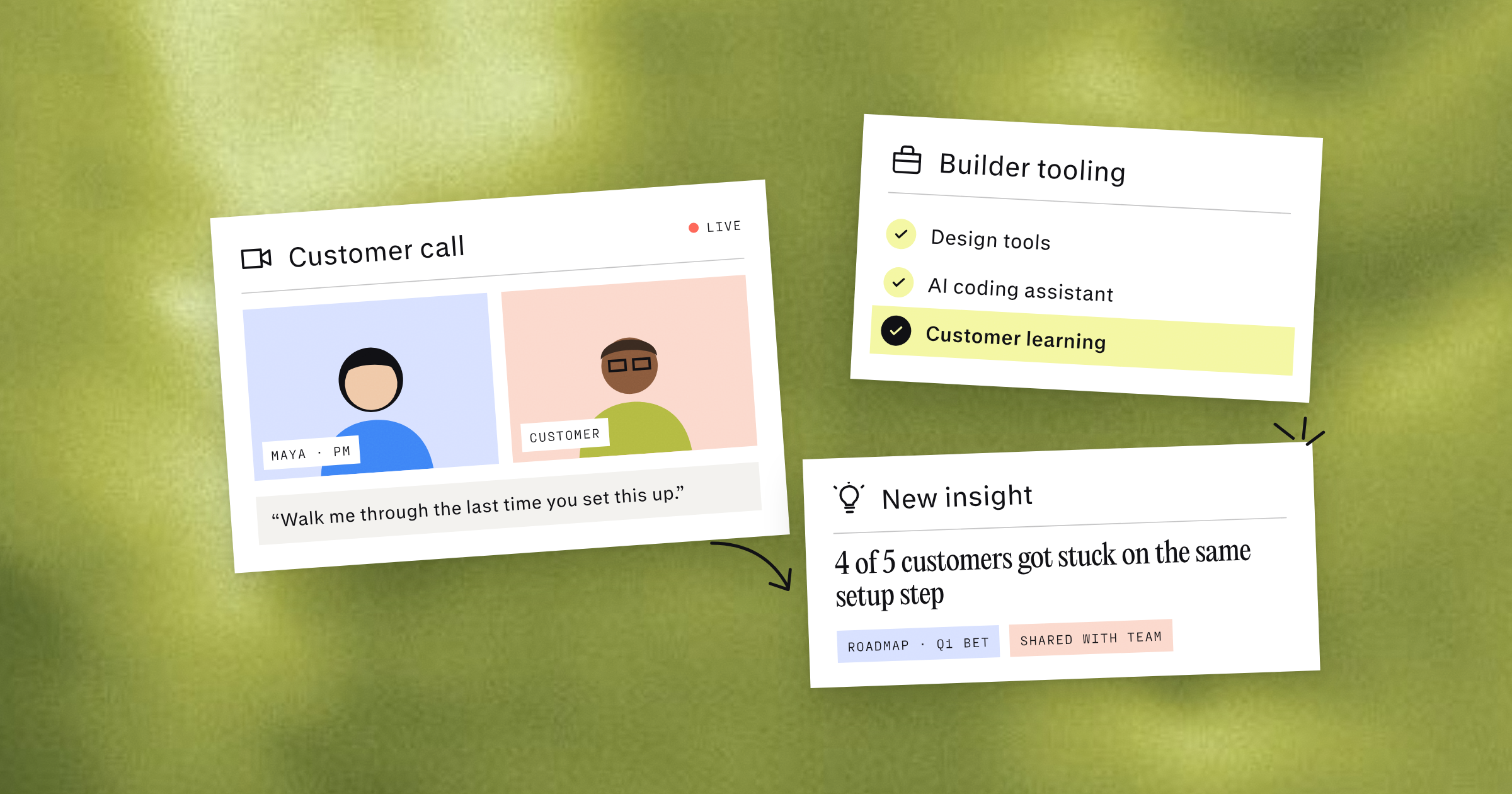
Your PMs, designers and engineers already rely on tools you pay for without much debate, from design software to AI coding assistants. Put customer learning in that same stack and finance sees something your whole product org uses to get the evidence behind its bets.
When AI makes building fast and cheap, the edge moves to knowing what's worth building. Dashboards tell your team what users did. A conversation tells them why, and what job they were trying to get done.
That's why the PMs and designers making the calls need to hear from customers directly, not just through a readout. A feature request heard firsthand often turns out to be a different problem, and usually points to a smaller, better thing to build. Engineers who watch a customer struggle tend to ship a fix faster, too.
We made the full case earlier this month in The Product Leader's Edge in 2027: Teams That Talk to Their Own Users. Stronger roadmap reviews, braver bets and better use of engineering time all start with teams that talk to their own users every week. Funding customer learning as builder tooling is how that habit sticks.
Here are five reasons customer learning belongs in your builder tooling budget, and what it takes to make the move pay off.
1. Builders are asking for it
Noam Segal, an AI insights manager at Figma who previously led user research at Airbnb and Meta, and Lenny Rachitsky, author of Lenny's Newsletter, surveyed product people on how they use AI and found PMs hungry to apply it upstream, to the messy work of understanding what to build. In their data, user research showed the largest demand gap of any task.
Julie Zhuo, former VP of product design at Facebook, wrote this spring that ideas need to meet reality early, and that excellent teams force themselves into that kind of contact with user truth.
For leaders, that demand is the budget case. Your builders already want to learn from customers, and if you don't fund a good way to do it, they'll piece one together without your approval or company standards. Funding it as builder tooling turns that curiosity into evidence you can trust.
2. Every roadmap bet comes with evidence
When the teams placing bets are the ones talking to customers, roadmap reviews change. Instead of debating opinions, you're asking what customers said and what the team changed because of it. That makes it easier to back the bold bets and cut the weak ones before your engineers spend a quarter building them.
For a product leader, this goes beyond better decisions. You're the one who answers for the roadmap when the CEO asks why a bet missed, or when sales asks why their request didn't make the cut. Customer evidence gives you a defensible answer every time, and it makes saying no to the loudest voice in the room a lot less personal.
3. Learning keeps pace with building
Your teams ship every week. When every customer question has to go through the research team, that team becomes a bottleneck for product decisions. If a study takes weeks, your product team gets the answer after they've already decided, because they can't afford to wait. When builders hear directly from customers inside their own cycle, learning shows up while the work is still easy to change, and the habit sticks because it's part of how the team already works.
For a product leader, that's the difference between steering and reacting. You hear about problems while there's still time to change course, not in a postmortem, and your teams' speed turns into progress instead of rework.
4. The spend scales with the people who use it
Research budgets are sized for one small team, so they're the first thing trimmed when money gets tight and the last thing to grow when the company does. Builder tooling works the other way. It's sized by headcount, approved as a cost of shipping, and grows every time you hire. Finance already knows how to say yes to it.
That changes the question finance asks. Measured against one research team, customer learning looks like a cost center. Measured against every PM and designer it helps make better calls, it's one of the cheapest tools in your stack, and that's the version that survives budget season.
5. Good research practice comes built in
When more people talk to customers, it's natural to assume that the research quality bar could slip. Who can contact which customers? How often? With what consent? Most orgs assume the research team will sort that out. But plenty of product orgs don't have a research lead, and the (lucky!) ones that do shouldn't have to spend weeks setting up tools and writing rules before anyone talks to a customer.
Marty Cagan, founder of Silicon Valley Product Group, wrote about the experimentation team, which in his model includes user research and data science. Their job, he argues, is to enable the product teams to do as much as possible themselves.
That's why the standard should live in the tooling, not on one person's to-do list. At Rally, we build best practices into the workspace from day one, and Rally Agent helps set it up with default governance rules for who can contact which customers, how often, and with what consent.
If you have a research lead, they get to spend their time where it counts: collaborating on high quality, strategic research that informs your roadmap. If you don't, your builders still start with guardrails that keep conversations high quality and keep customers from getting flooded with requests.
Here's the simplest reason of all: talking to customers is one of the easiest ways to look good as a product leader. Walk into a roadmap review or board meeting with what customers told your team, and your calls carry more weight than anyone's opinion. That's why it deserves a budget that matches.
Making the case starts with a few answers about where your org is today.
Five questions for your next leadership meeting
- Which budget does customer learning sit in today, and who actually uses what it buys?
- How many of our PMs and designers talked to a customer in the last month?
- Which of our 2027 bets would we feel better about if those teams heard from customers every week?
- What would our research lead need to set the standard for a group ten times larger?
- Which team has a bet big enough next quarter to pilot this?
Rally helps every product team talk to their own users, inside the standards your research team sets. If you want to see what that looks like inside your org, book a demo with our team.
Rally’s Research Ops Platform enables you to do better research in less time. Find out how you can use Rally to empower your teams to talk to their users, without disjointed tooling and spreadsheets. Explore Rally now by setting up a demo.