
Build Your Own Research Agent vs. Buy: What Product & UXR Teams Need to Know
Thinking about building or buying a research agent? Explore the infrastructure, governance, integrations, and costs behind the decision.
Agentic AI has dramatically lowered the barrier to conducting user research.
Conventional AI lets any product stakeholder turn questions into a research plan, generate interview questions, analyze feedback, and explore customer themes in a matter of seconds. An AI agent can go further, independently executing any of these steps to accomplish them faster and more consistently than any traditional software.
That creates a compelling opportunity for Product, Design, UXR, and Research Ops teams. A research agent can give more people the ability to initiate research while preserving the standards that make research useful and trustworthy.
It also creates a practical technology decision. Should you build your own research agent, or buy one? The answer depends on more than the quality of the underlying AI.
A research agent needs access to real users, organizational context, research tools and data, permissions, governance, and quality controls. Its integrations need to keep working as your technology stack changes. AI may be the most visible part of the system, but the infrastructure underneath it determines what the agent can actually do.
What is a research agent?
A research agent is an AI-powered system that can take action across multiple steps of a research workflow.
A chatbot might generate interview questions. An agent can potentially turn a research objective into a plan, identify an appropriate audience, recruit participants, conduct interviews or surveys, analyze responses, and store the findings. The key difference is action. An agent can reason about what needs to happen next, use connected tools, and continue through a workflow without human oversight.
That creates a way to distribute appropriate research activities across the product organization. PMs and designers can initiate agent-run research closer to the decisions they are making, while UXR and Research Ops establish the methods, guardrails, and infrastructure that these agents must follow. Research happens faster but rigor is maintained.
Where does MCP fit?
MCP, or Model Context Protocol, provides a standardized way for AI applications to interact with external tools and data. For a research agent, MCP can help connect the AI to systems such as research repositories, participant databases, survey platforms, analytics tools, and internal knowledge bases.
But MCP is the connective layer, not the complete solution. Someone still has to build or configure those connections, establish permissions, determine what the Agent can access, and maintain the integrations. MCP can standardize how an agent connects to systems. It doesn't eliminate the systems themselves.
The connection between MCP and Agents
Think of MCP as a toolbox and the agent as the mechanic.
The MCP toolbox holds a set of individual tools, each built to do one specific job well: create a study, add a screener question, schedule a session. On its own, a toolbox cannot build anything. It just sits there, looking capable, waiting for someone who actually knows which end of the wrench to hold.
That is the agent's job: it picks up the tools, decides which one goes where, and turns "we need to talk to customers" into an actual research plan instead of an organized pile of parts. This is also the part of the build-vs-buy decision people tend to skip past. Buying a research agent does not just mean buying a mechanic; it means buying a mechanic who already knows your garage, follows your shop's safety rules, and will not reorganize the toolbox the moment your back is turned.
Build your own, and you get to assemble both the tools and the mechanic yourself, which is a fine plan, provided your team has the time, the parts, and the patience.
What does it take to build a research agent?
A production-grade research agent requires considerably more than an AI model, prompts, and a few APIs.
You need to define the workflows it will support, connect the underlying research systems, establish safe access to participants, and incorporate organizational context such as research standards, customer segments, terminology, and existing findings.
You also need governance. Who can launch a study? Who can recruit customers? What data can the Agent access? Which studies require researcher review? How are consent and participant protections handled?
Then comes quality and maintenance. Someone needs to monitor research quality, evaluate Agent behavior, update integrations, manage changing models, and support users.
The AI layer is only one part of the project. The infrastructure underneath it is where much of the work lives.
One agent vs. a collection of AI skills
Building rarely stays limited to one agent.
A team might start with a research-planning skill, then add participant recruitment, interview assistance, survey creation, synthesis, and reporting. Each capability may solve a legitimate problem, but over time the organization can end up maintaining a collection of independent agents, prompts, MCP connections, APIs, and automations.
That creates another infrastructure problem. Someone has to make those capabilities work together, manage permissions, enforce consistent research standards, and update the system when underlying tools change. This is generally referred to as an orchestration layer, and it's no small feat to develop and maintain.
A centralized, configurable research agent offers a different model; it comes with its own orchestration layer built in. Research Ops can establish workflows, organizational context, permissions, and governance in one place, while PMs and designers access the capabilities they need.
Build vs. buy and the software development iron triangle
A useful way to evaluate the decision is the familiar software development iron triangle: budget, time, and scope.
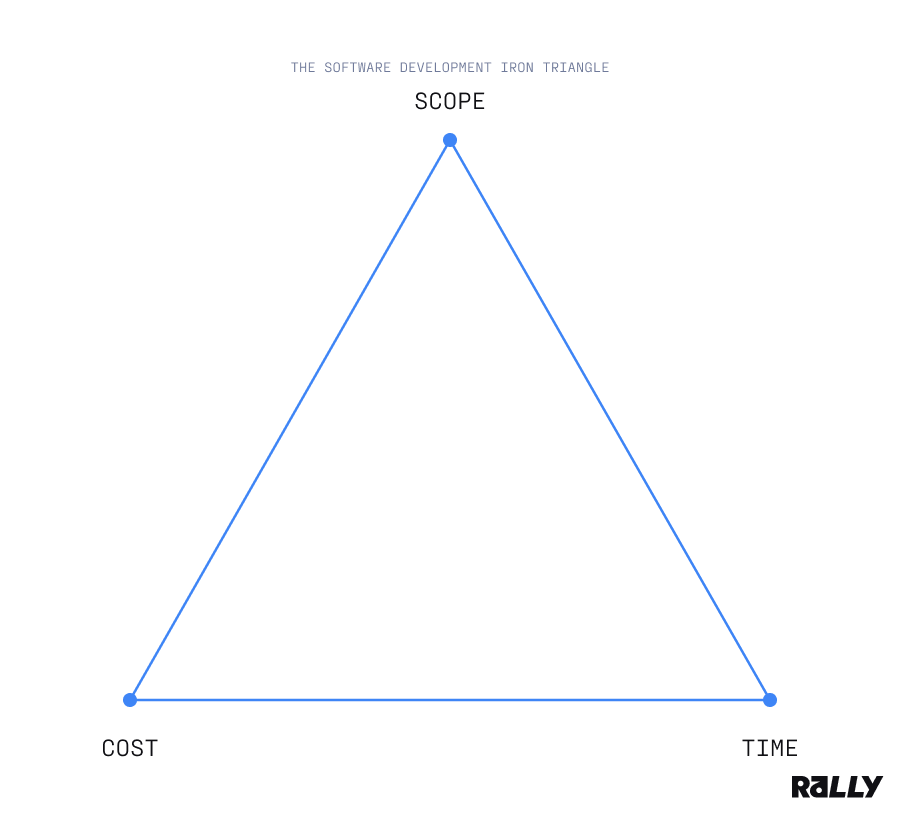
Building can reduce software spend while consuming engineering time and capacity. Buying increases software spend but can accelerate implementation. Building gives you maximum control over scope, while a commercial platform provides a defined set of capabilities that can often be configured to your organization, and is backed by a support organization and contractual guarantees.
Ask:
Which resource does your team have more access to: budget, time, or engineering capacity?
If you have engineering capacity and time, building may make sense, particularly when your workflows are highly specialized or your existing infrastructure is strong.
If you have the budget but limited engineering capacity, or need to move quickly, buying may make more sense.
Scope matters, too. If your requirements depend on proprietary systems or highly differentiated workflows, ownership may justify the investment in building. If your requirements align with an existing platform, rebuilding those capabilities may add cost without creating meaningful differentiation.
The real build-vs.-buy calculation
Don't compare a software subscription with the cost of writing code. Compare the total investment required to achieve the same research capability.
Build = Engineering + integrations + research infrastructure + governance + implementation + maintenance + opportunity cost
Buy = Software + implementation + configuration + integrations + governance + administration + ongoing subscription
The exact pricing numbers will vary, but the exercise exposes costs that are easy to overlook, particularly participant infrastructure, security, governance, maintenance, and engineering opportunity cost.
Evaluate the infrastructure, not just the Agent
Before choosing a path, ask:
- Can it reach the right real users?
- Can it recruit and screen participants?
- Can it access relevant organizational context and previous research?
- Can it work with your existing tools?
- Can it enforce permissions and research guardrails?
- Can Research Ops manage the system centrally?
- Who maintains the integrations?
- Who evaluates research quality and Agent performance?
These questions get to the heart of the decision.
AI has made it much easier to generate research plans, ask questions, and interact with users. The harder problem is connecting that intelligence to the systems, people, context, permissions, and governance required to conduct research safely and usefully.
A team can absolutely build its own research agent. The question is whether building the infrastructure underneath it is where your organization wants to invest its time and engineering capacity.
A research agent is only as good as the research infrastructure it can access.
Start with the iron triangle. Understand the scope you actually need. Inventory the infrastructure you already have. Then decide what you want to own and what you would rather have a specialized platform provide.
That will tell you far more about whether to build or buy than the capabilities of any AI model alone.
How Rally can help
If you want to test-drive the buy scenario, and set a benchmark for what agentic AI can do to accelerate product research, schedule your personalized Rally demo today.
Rally’s Research Ops Platform enables you to do better research in less time. Find out how you can use Rally to empower your teams to talk to their users, without disjointed tooling and spreadsheets. Explore Rally now by setting up a demo.