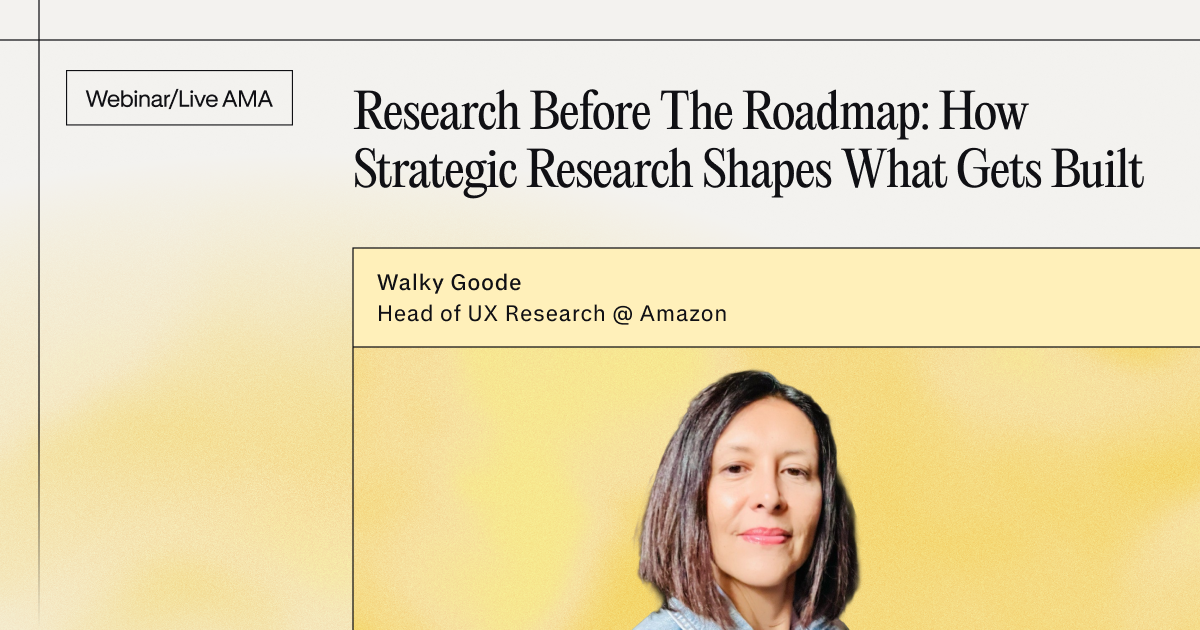
Research Before the Roadmap: How Strategic Research Shapes What Gets Built
Most people picture user research as the thing that happens after a prototype exists. In our latest AMA, Walky Goode, Head of UX Research at Amazon, made the case for starting much earlier, before there is even a roadmap to react to.
Walky leads the research strategy team within Amazon's central science organization. Her team runs strategic qualitative research that surfaces opportunities for products, programs, projects and policies, all before any product team picks them up.
Here's what we took away from the conversation.
What research before the roadmap looks like
Evaluative research asks whether people can use what you built. Are they confused? Can they get through the workflow? Will they successfully adopt it?
Strategic research asks a different question: what problem should we be solving at all? Walky's team aims to help leaders understand what customers need to accomplish and where they get stuck before anyone jumps to solutions.
“Customers don't think in feature sets. They're just thinking, I need to accomplish this task, I need to get this job done.”
Defining the problem space first gives teams room to choose the right response whether that's a product, new program, or even just better documentation. Either way, the company avoids spending time and engineering effort on something users don't need.
Deciding which opportunities are worth pursuing
Walky's team maps the environment users work in, who they interact with, and the resources they rely on. Uncovered gaps in that experience become candidate opportunities to pursue. To decide which ones get research investment, they weigh three criteria:
- Strategic impact for the business. Does it answer a big open question for leadership, or inform a decision that requires heavy engineering or design effort?
- Scope of user impact. Does it affect many users, or a small subset? A small group can still matter a lot if it's your most valuable customers. Does it touch the whole workflow, or one step that causes drop-off?
- Value to the user. What would solving this actually give people?
Together, these three factors determine whether an opportunity gets a rigorous study, a lighter pass, or a small evaluative test.
Matching research to the decision
To explain when strategic research earns its time, Walky borrowed an Amazon concept: one-way and two-way door decisions.
- A one-way door is hard or nearly impossible to walk back: a major engineering or business investment, or a move that costs you customer trust.
- A two-way door can be tried, measured and reverted.
This framing matters even more now that AI lets teams prototype and ship faster. Speed doesn't make a one-way door less risky. For those decisions, research still needs to come first, even if that means speeding up the research process to keep pace. For two-way doors, researchers can help partners test and evaluate their own prototypes and move quickly.
Earning the seat, and proving the impact
You earn a seat at the table through what you bring to it, Walky said. That means doing your homework, forming a research point of view on what matters most, and speaking the language of the business.
“We understand that we need to speak the language of our users. In the same manner, we need to speak the language of our internal stakeholders.”
In practice, that means tailoring the message and delivery of research:
- Product and business partners: the cost of low adoption, or of customers leaving the product.
- Engineering: the cost of building something nobody uses, or something that isn't the solution people need.
- Leadership: risk and investment, framed by a short document that surfaces what they aren't seeing yet and circulates up the chain.
Measuring the impact of early research is hard. One study Walky ran as an IC took a year and a half to ship. Her approach is to measure how research changes decisions, not just launches:
- Did it shape a roadmap, a PR/FAQ or a PRD?
- Did it speed up a release, or stop something from being built? Stopping the wrong thing is a real win, think of what it saves the company in terms of time and investment.
- Keep tabs on milestones and check in with partners as they design and build, then document where your research shows up.
One attendee asked how to stay visible when PMs and designers absorb the research and leadership never sees where it came from. Walky's answer: build trust from the bottom up. When partners know they succeeded because of research, they become your champions and want research's name on their decisions.
And when org churn means stakeholders keep changing? Her team builds “101 packages” for new partners: the key things to know about the user, the studies that set the product's current direction, and a reading list. It speeds up their onboarding and establishes the researcher as the expert from day one.
Handoffs that actually land
The handoff starts at kickoff, not at the readout. Product partners are subject-matter experts too, so Walky scopes studies with them: building the research brief together and agreeing on primary and secondary questions.
What makes a handoff work:
- Bring partners into sessions. Watching customers firsthand means no one is surprised by the findings. If partners can't attend, share early signals before the report, noting what's not working or what people love.
- Workshop the findings. Turn customer problems into potential solutions together, and agree who owns each one: design, engineering, product or more research.
- Leave lasting artifacts. Design principles, personas and customer journeys keep the research in the room long after the readout.
What makes one fall flat: being prescriptive. Researchers bring the problem and the customer evidence; partners bring the solution. Telling them how to design or code it rarely lands.
The same applies when PMs cherry-pick findings to support a decision they've already made, a problem, Walky noted, that long predates AI. Product managers should talk to customers. Researchers can help them do it well by teaching them about common biases and how to question objectively, so they don't build on the good feedback and ignore the bad.
After the handoff, Walky's team stays connected, and artifacts keep the research present passively. Actively, they follow the roadmap, check in at key milestones and offer office hours, because a designer working on a solution a month later will still have questions about what users did.
Scaling a small team
Researchers will always be outnumbered by designers, PMs and engineers. Walky sees that as part of what makes the role special, and as a reason not to try to answer everything.
“You're never going to be able to answer every single question that your partners have.”
Instead, her team focuses on the most important, riskiest and most uncertain questions, then scales the rest:
- A research archive so partners can find past insights that are adjacent to their problem.
- Design principles that help teams reason through solutions without a new study.
- DIY research with guardrails. Decide which questions designers and PMs can answer themselves, and make sure they feel comfortable coming back when something in their sessions looks off.
- Piggyback studies. When a question matters but doesn't warrant its own study, add it to an existing one — a 45-minute session plus a 15-minute module for another team, run by a researcher with real users. Several attendees shared they do the same, calling it “bundling.”
Readouts scale too. Stakeholders are the users of your reports, so meet them where they are: a six-page report for partners who need the detail, four pages for leaders, one page for executives, and a single paragraph for the C-suite.
AI and where research careers are heading
Walky's team keeps testing AI tools across the whole research cycle, since something that didn't work last month might work now. Today they use AI to:
- Pressure-test hypotheses for research briefs and discussion guides
- Transcribe and clean up transcripts
- Find patterns and test hypotheses during analysis
- Refine messaging and pull supporting evidence from transcripts and past reports
Synthesis is where she draws the line. Researchers should lead it, because their name is on the report.
“It's not the AI's name, even if the AI wrote it. It's going to be you, so you need to feel that you own it and can explain and justify all the insights.”
On synthetic users, her view is that it depends on the problem space. Well-established journeys like shopping, where tastes and trends are relatively stable, may be modeled reasonably well. Highly reactive environments are a different story; she isn't sure synthetic personas can yet capture how quickly humans react.
The role itself has changed a lot over her career. Research started as a nice-to-have at the end: test the prototype, check where people click. It moved earlier as teams realized research could save them from building the wrong prototype in the first place. Now it extends past the app into handoffs, discovery, sign-in and sharing - less product research, more experience research.
To stay ready for what's next, Walky suggests researchers:
- Own the human, not the product. Become the expert on what people do before, during and after using it.
- Go beyond usability testing toward experiential research on things still being developed.
- Stay curious. It's the trait she looks for first when hiring: how candidates define problems and keep up with technology and UX advances.
- Look past the job title. Research strategy, service design and market research roles may all fit, and they'll teach you things you'd miss staying in one lane.
The one piece of advice: don't wait for a request
Asked for one tip for researchers who want to shape the roadmap instead of reacting to it, Walky didn't hesitate: don't wait for a research request.
If you understand your customers and sense a problem, do the homework and bring it to leadership. Helping them find a problem they didn't know existed is how they see your value. One practical way to start: add an extra 15 to 20 minutes to sessions you're already running to explore a hunch. If it pans out, take it back to your partners.
Thanks to Walky for a generous, practical conversation, and to everyone who joined and kept the chat full of great questions. Walky invited attendees to connect with her on LinkedIn.
Missed it live? Watch the full AMA recording.
Rally’s Research Ops Platform enables you to do better research in less time. Find out how you can use Rally to empower your teams to talk to their users, without disjointed tooling and spreadsheets. Explore Rally now by setting up a demo.