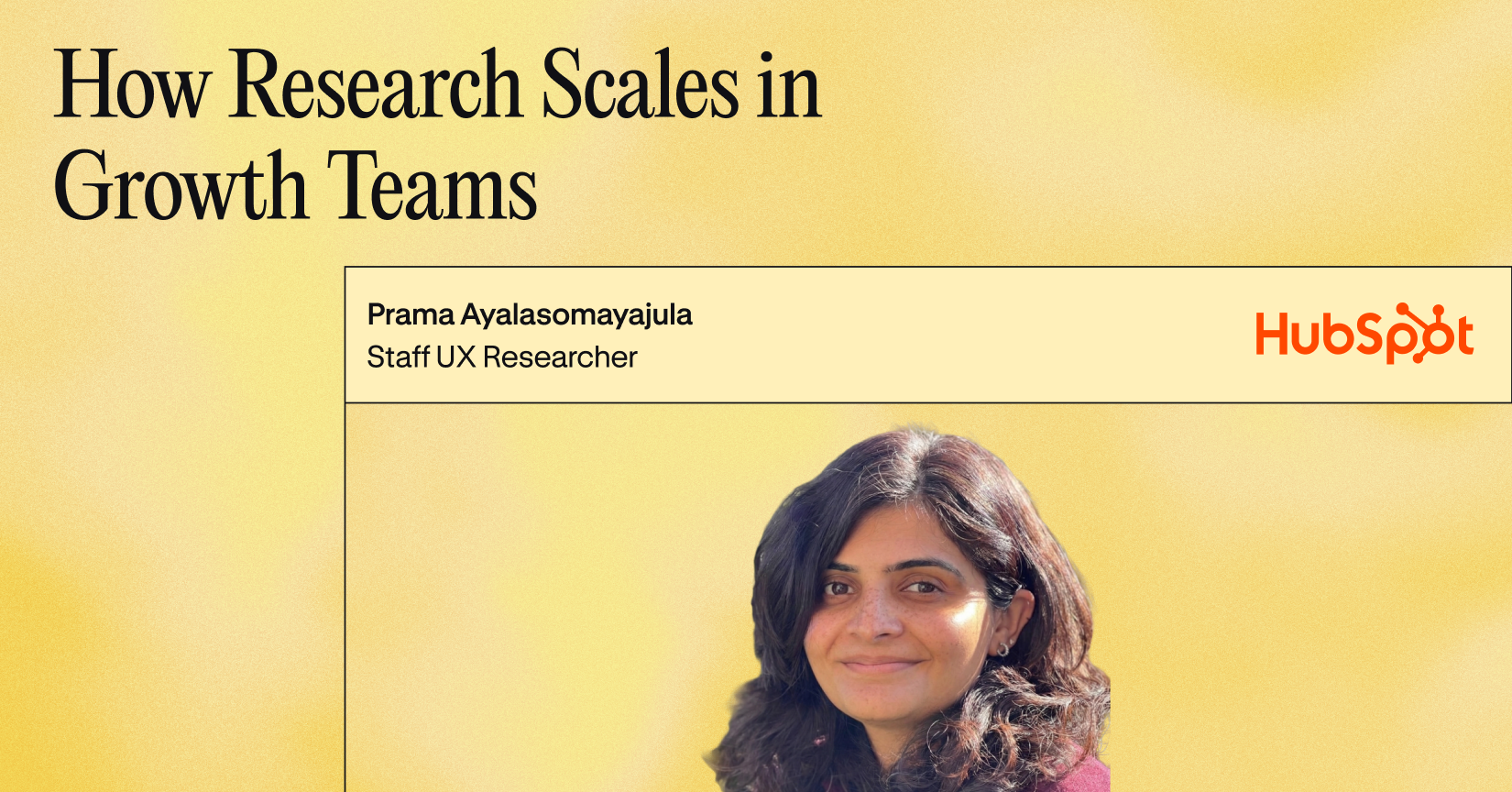
Prama Ayalasomayajula on how Research scales in growth teams
Lorem ipsum dolor sit amet, consectetur adipiscing elit, sed do eiusmod tempor incididunt ut labore et dolore magna aliqua.
Fast-moving product teams don’t fail at discovery because they don’t talk to customers.
They fail because discovery gets treated like an activity instead of an operating system.
In this AMA, Prama Ayalasomayajula - Staff UX Researcher at HubSpot - joins Rally to unpack why discovery so often breaks down inside growth organizations, even when teams are “doing research.” Drawing on her experience across Uber, Meta, Zalando, and now HubSpot, Prama shares what it really takes to make research usable, trusted, and fast - without sacrificing rigor.
This conversation is a must-watch for researchers navigating high-pressure environments where speed, business impact, and customer understanding are inseparable.
About Prama
Prama Ayalasomayajula is a Staff UX Researcher at HubSpot, where she works on growth and customer journey teams focused on acquisition, activation, retention, and monetization.
Over the course of her career, Prama has worked inside some of the fastest-moving product organizations in tech, including Uber, Meta, and Zalando, partnering closely with product, design, marketing, and sales teams to deliver customer insights under intense business pressure.
Her work sits at the intersection of research rigor, operational scale, and business impact - with a particular focus on making discovery actionable in environments where speed matters and trust must be earned. Prama is known for her pragmatic approach to research, her emphasis on cross-functional relationships, and her belief that good discovery is less about methods and more about decision-making.
Discovery Fails When It’s Reduced to “Talking to Customers”
One of Prama’s sharpest reframes: Talking to customers is actually not doing research.
In low-maturity organizations, discovery often stops at conversations with customers. But without planning, clear questions, analysis, and synthesis, those conversations don’t translate into decisions.
In higher-maturity orgs, researchers often absorb that missing work - on top of their core responsibilities - creating a different failure mode: burnout and bandwidth collapse.
“Talking to customers is actually not doing research. And interviews are not necessarily the only methodology available. And, assuming that interview is the methodology of choice, doing interviews is just 20% of the job.
"You still have to come up with a plan. You have to identify the right questions, you have to be able to analyze, you'll have to be able to connect the analysis that you have to the questions that you've started with.
"All of this work needs to happen.”
Discovery breaks not because teams don’t care - but because they lack the operational scaffolding to turn signals into decisions.
Growth Teams Don’t Have a Speed Problem - They Have an Operations Problem
In growth environments, research doesn’t get a long grace period. If insights aren’t reliable, teams feel it immediately -- and trust erodes fast.
Prama argues that research isn’t inherently slow. What slows it down is friction:
- Poor access to customers
- No clear ownership of research operations
- Weak cross-functional relationships
The unlock isn’t a faster method - it’s customer access.
Her most effective tactic? Building durable relationships with sales, marketing, support, and ops teams - the people already closest to customers.
“I need to figure out how I unlock access to customers. If I can unlock that, then I can move fairly quickly.
"But if that gets blocked, if I don't have that kind of operational support, it could be that there's a research operations team that can help me unblock it. But in many organisations, there aren't research operations teams. So how do you sort of do this yourself?”
Stakeholder Buy-In Is Earned, Not Requested
When asked what most often blocks research, the audience overwhelmingly pointed to stakeholder buy-in. Prama wasn’t surprised.
Her approach flips the script:
- Start by understanding a stakeholder’s history with research
- Identify where trust broke down
- Deliver small, implementable wins early
Sometimes, that means not running new research at all - just connecting teams to insights that already exist.
“My goal is to not do just a research project. My goal is to actually help [my stakeholders] with that decision making.
"If they understand that, if they know that I can help them with that, and I'll help them unlock that, they will start trusting me. And this goes with the product team, but also with marketing, sales, and customer support.”
That mindset shift - away from “research as a service” and toward research as a decision partner - is what turns skeptics into collaborators.
Rigor, Speed, and Risk Are a Three-Way Tradeoff
When timelines are tight (and they always are), Prama anchors conversations around risk.
If the bet is low-risk, maybe lightweight methods - or even no research - are fine.
If the bet is high-risk, speed without rigor becomes expensive.
Her advice:
- Be explicit about what’s possible in a given timeframe
- Name the limits of the data upfront
- Negotiate scope, sequencing, or phased learning
“You need to communicate with your team and say, 'hey, in this timeline that you're giving me, this is what I can do, and this is not the most rigorous way of doing this.'
"I am responsible for my research insight. So, I need to be very honest about the rigor of it from the beginning.”
AI Can Accelerate Research, But It Can’t Replace Judgment
AI came up repeatedly, and Prama’s take was grounded and clear-eyed.
AI tools can:
- Speed up summarization
- Support writing and analysis
- Enable new formats like adaptive surveys
But they don’t replace:
- Context
- Cultural nuance
- Empathy
- Bias mitigation
“You just can't expect AI to do everything for you without interjection, without ensuring that it is quality. So while I think it's changing how we do research, what tools we use today, what are the practices we follow in some ways, I think research as a practice, the processes we follow, all of that is still the same. …
"And inherently research is such a human understanding pursuit, right? If you're also sort of passing that on to AI, I don't know if that's the right way to think about it.”
AI changes how research gets done - not why or what good research requires.
The Researcher’s Real Value Isn’t Methods -- It’s Judgment
PMs and designers can (and should) do some research. But Prama highlighted what makes dedicated researchers essential:
- Deep training in bias awareness and mitigation
- Comfort delivering hard feedback on ideas they didn’t create
- The discipline of turning messy input into reliable insight
Research isn’t just execution - it’s practice, refined over years.
“It's just not enough that I'm aware that I could be biased. I have to do something about it, right? … If you want to rely on rigorous insights, you need a process in place. And the question is, who has the time to do the process and who has the training to do it.”
The Throughline: Relationships Are the Real Infrastructure
Across every topic - speed, rigor, buy-in, AI - the same theme surfaced again and again:
Research scales through relationships.
With product teams. With leadership. With go-to-market teams. With allies who help advocate when timelines and incentives collide. When those relationships exist, research doesn’t get bypassed - it gets pulled in.
"Being able to build those relationships, being able to drive impact, and being able to have these difficult conversations where you can work with your team and say, 'hey, you know what? At this point in time, this is a really risky bet. This timeline can be moved. And we can do a piecemeal of it in the next one week, but the more risky part is going to take some time because it is complex research.' I think having that communication is important and expecting your stakeholders to know all of that is not fair. You need to have that relationship and they're relying on you to tell them that."
TL;DR | Key Takeaways
- Proactive research runs on relationships. The fastest way to make discovery stick isn’t better methods—it’s earning trust with product, growth, marketing, and sales partners.
- Access is built, not granted. Ongoing relationships with internal teams and customers make recruitment easier, conversations more candid, and insights more relevant.
- Speed follows trust. When stakeholders believe in research—and in the researcher—decisions happen faster and findings don’t need to be defended every time.
- Growth research is a team sport. Researchers who embed early, communicate often, and co-own outcomes are far more likely to influence roadmaps and experiments.
- Impact shows up in behavior change. Research matters most when strong relationships turn insights into action—not just alignment, but real movement.
Thanks, Prama
A huge thank you to Prama Ayalasomayajula for joining Rally and sharing such a grounded, honest perspective on what it really takes to make research work inside growth organizations.
From reframing discovery as an operational system - not a set of interviews - to breaking down how trust, access, and relationships shape research impact, Prama offered insights that resonated deeply with researchers and product leaders alike.
We’re grateful for the candor, the practical advice, and the reminder that rigorous research isn’t slow -- it just needs the right foundations. Thank you, Prama, for an incredibly thoughtful AMA.
Rally’s Research Ops Platform enables you to do better research in less time. Find out how you can use Rally to empower your teams to talk to their users, without disjointed tooling and spreadsheets. Explore Rally now by setting up a demo.